
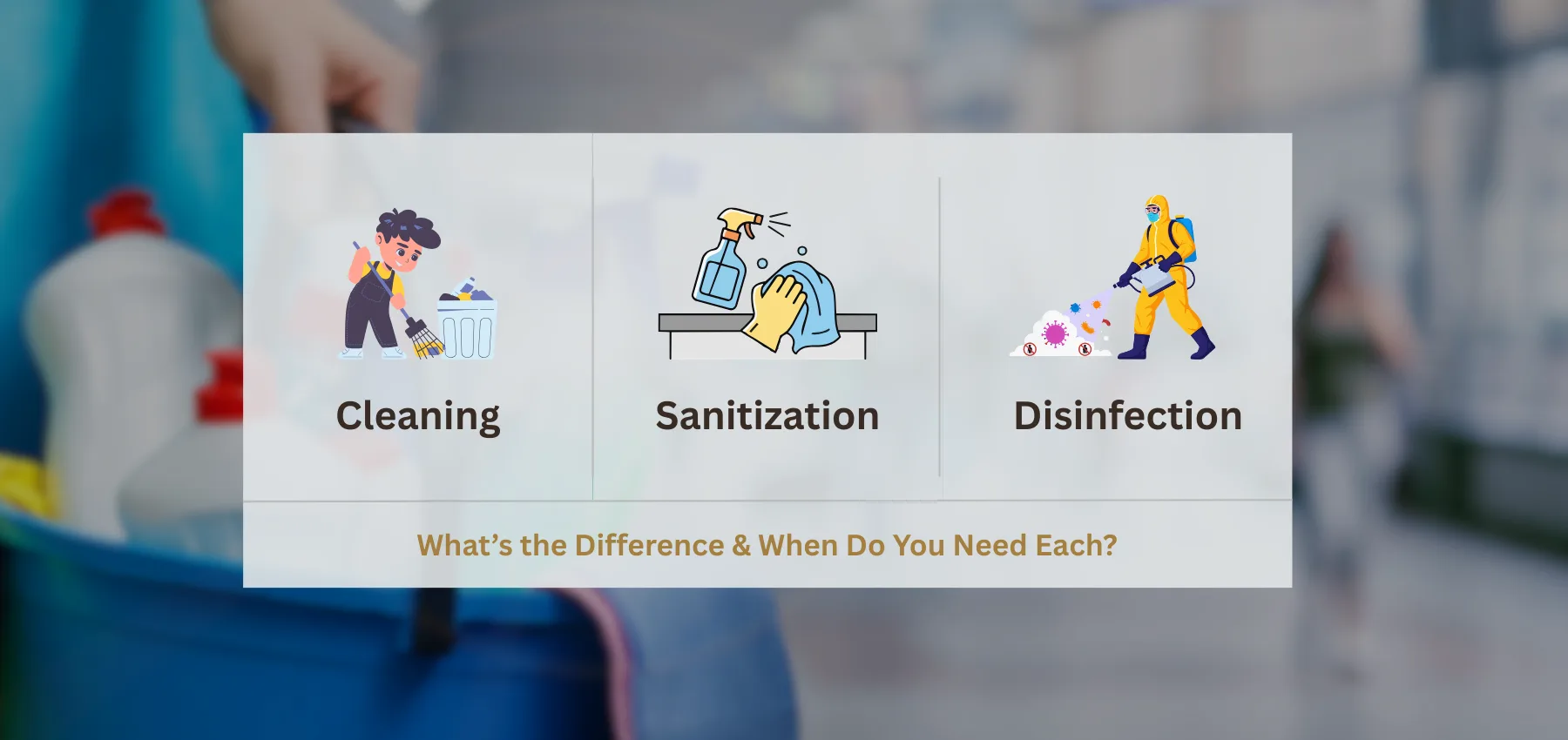
Quick Overview: The Key Differences
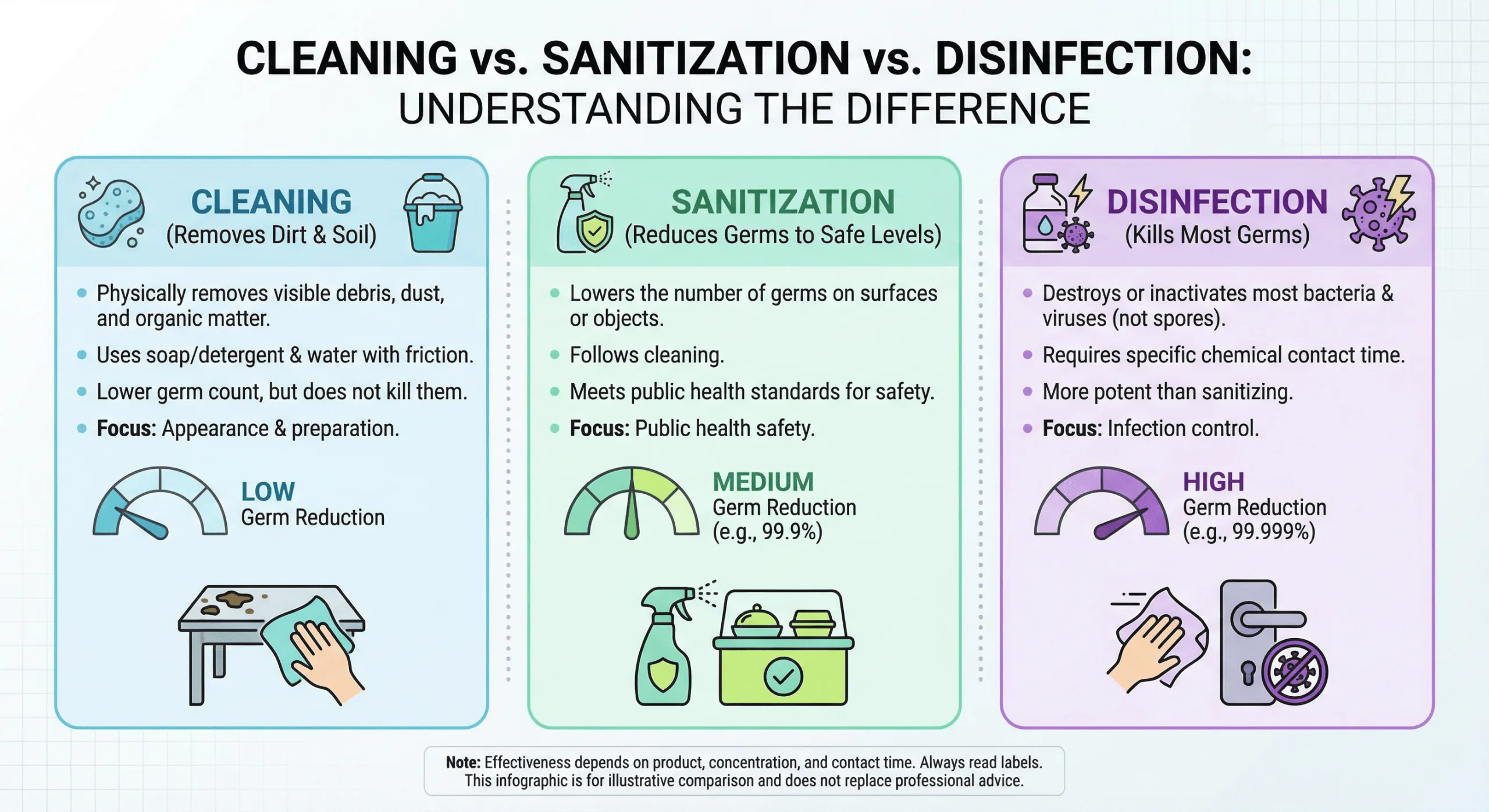
Before we dive deep, here’s a quick comparison table:
| Aspect | Cleaning | Sanitization | Disinfection |
|---|---|---|---|
| What it does | Removes dirt, dust, debris | Reduces germs to safe levels | Kills 99.9%+ of germs & viruses |
| Germ reduction | Removes some germs physically | Kills 99.9% of bacteria | Kills 99.999% of bacteria, viruses, fungi |
| Method | Soap/detergent + water + scrubbing | Weaker chemicals or heat | Stronger chemical disinfectants |
| Time required | Minutes | 30 seconds contact time | 3–10 minutes contact time |
| When to use | Daily maintenance | Food prep, baby items, quick applications | After illness, high-risk situations |
| Cost | Lowest | Medium | Highest |
| KKM/MOH Standard | Basic hygiene requirement | Food safety requirement | Healthcare & outbreak response |
Now let’s explore each process in detail.
What is Cleaning? (The Foundation of Hygiene)
Definition:
Cleaning removes visible dirt and some germs using soap, water, and scrubbing. Essential first step before sanitization or disinfection.
How Cleaning Works:
Cleaning physically removes:
- Visible dirt and dust
- Grease and grime
- Food particles and organic matter
- Some germs (but doesn’t kill them)
Common Methods in Malaysia:
- Mopping, sweeping, dusting
- Wiping surfaces with wet cloths
- Vacuuming carpets and upholstery
When Cleaning is Enough:
- Daily home maintenance
- Low-traffic areas (bedrooms, storage)
- General offices (combined with hand hygiene)
What Cleaning Cannot Do:
- Cannot kill viruses (COVID-19, influenza, HFMD)
- Cannot eliminate harmful bacteria (E.coli, Salmonella)
- Cannot remove allergens completely (dust mites, pet dander)
- Cannot protect against disease spread in high-risk areas
- Cannot meet food safety standards (requires sanitization)
What is Sanitization? (Reduce Germs to Safe Levels)
Definition:
Sanitization reduces bacterial contaminants on surfaces to levels considered safe under public health standards. It uses weaker chemical solutions or heat to lower germs without full disinfection.
How Sanitization Works:
- Removes 99.999% of a test bacterium in 30 seconds
- Faster than disinfection, stronger than cleaning
- Safe for frequent use (weaker chemicals)
- Economical for regular application
Common Sanitization Methods
Chemical Sanitizers:
- Chlorine-based solutions (diluted bleach)
- Quaternary ammonium compounds (quats)
- Alcohol-based sprays (70%)
Heat Sanitization:
- Boiling water (baby bottles, utensils)
- Steam (certain fabrics/surfaces)
- High-temp dishwashers
When You Need Sanitization:
- Food prep areas (kitchen counters, cutting boards, utensils – MOH requirement)
- Restaurants & F&B businesses (food contact surfaces)
- Baby items (bottles, pacifiers, toys)
- High-touch surfaces between disinfections (door handles, phones, keyboards)
- Non-porous surfaces that can’t handle strong disinfectants
- Quick germ reduction when full disinfection isn’t feasible
Limitations of Sanitization:
- Doesn’t kill all viruses (less effective against many viral pathogens)
- Not suitable for outbreak situations or sick individuals
- Won’t eliminate fungi or resistant organisms
- Requires clean surfaces first – won’t work on dirty surfaces
- Not a replacement for routine disinfection in high-risk areas
What is Disinfection? (Killing Harmful Pathogens)
Definition:
Disinfection uses chemical agents to kill germs, bacteria, viruses, and fungi on surfaces. It is the strongest level of germ control outside medical sterilization.
Important: Disinfection should always follow cleaning, because dirt and debris reduce chemical effectiveness.
How Disinfection Works:
- Breaks down bacterial cell walls
- Inactivates viruses by destroying their protein coat
- Eliminates fungi and mold spores
- Kills pathogens that cause disease
Types of Disinfectants in Malaysia (MOH/KKM-approved)
| Disinfectant | Effective Against | Typical Use |
|---|---|---|
| Chlorine-based (Sodium Hypochlorite) | COVID-19, influenza, HFMD, bacteria | Floors, toilets, outbreak situations (1000-5000 ppm) |
| Quaternary Ammonium Compounds (Quats) | Most bacteria, some viruses | Daily disinfection, general surfaces |
| Hydrogen Peroxide | Wide range of pathogens | Sensitive surfaces, eco-friendly |
| Alcohol (70% Ethanol/Isopropanol) | Enveloped viruses, bacteria | Small surfaces, medical equipment |
| Rely+On Virkon | COVID-19 & 500+ pathogens | Hospital-grade, Halal-certified, multiple surfaces |
When Disinfection is Needed:
- Someone is sick (COVID-19, flu, HFMD, stomach virus)
- Healthcare facilities, schools, or childcare centers
- Food establishments after contamination or inspections
- High-risk environments with vulnerable people
- Post-flood, water damage, or mold risk
Professional Disinfection Service at PT Clean
PT Clean provides professional, MOH-compliant disinfection services across Malaysia.
Key Features:
- Uses KKM/MOH-approved disinfectants for safe and effective cleaning
- Multiple application methods: surface wiping, misting, electrostatic & pressure spraying
- Trained technicians ensure proper PPE, correct contact times, and safe application
- Certificates provided for compliance and record-keeping
Our Disinfection Service covers:
- Residential Homes – routine protection or after illness
- Construction Sites – pre-handover disinfection
- Schools & Education Centres – protect children and staff
- Hotels & Airbnb – guest safety and confidence
- Warehouses & Industrial Facilities – large-scale coverage
- Office Buildings – workplace hygiene compliance
- Confinement Centres – meet healthcare standards
Coverage Area:
- Major coverage: Kuala Lumpur & Selangor
Benefits of Our Service:
- Eliminates viruses, bacteria, fungi, and mold
- Reduces risk of disease transmission
- Ensures safe and healthy environments for family, employees, or customers
Check out our disinfection service in KL
The Correct Sequence: Clean FIRST, Then Disinfect
This is important: You MUST clean before you disinfect or sanitize. Here’s why:
Why Cleaning First Matters:
- Dirt blocks disinfectants – Organic matter shields germs from chemicals
- Chemicals can’t penetrate grime – Grease, dust, or dirt reduces effectiveness
- Wastes disinfectant – Spraying over dirt doesn’t kill germs properly
- Reduces effectiveness – Studies show disinfectants can be up to 80% less effective on dirty surfaces
- MOH/KKM guidelines – Malaysian health standards require cleaning before disinfection
Step-by-Step Process:
Step 1: CLEAN
- Remove visible dirt, dust, and debris
- Use soap/detergent and water
- Scrub and wipe surfaces thoroughly
- Rinse if needed
- Let surfaces air dry or wipe dry
Step 2: DISINFECT (if needed)
- Apply disinfectant to clean, dry surfaces
- Ensure full coverage (don’t miss spots)
- Follow contact time on product label (usually 3–10 minutes)
- Let surfaces air dry – don’t wipe immediately
- Ensure proper ventilation
Step 3: MAINTAIN
- Regular cleaning to prevent buildup
- Periodic disinfection based on usage and risk
- Monitor for illness or contamination
When Do You Need Each Process? Practical Scenarios
For Malaysian Homes
| Situation | What You Need | Why |
|---|---|---|
| Daily tidying | Cleaning | Remove dust, keep home neat |
| Kitchen after cooking | Cleaning + Sanitization | Food safety – reduce bacteria on counters |
| Someone has flu/COVID | Cleaning + Disinfection | Kill viruses to prevent spread |
| Bathroom cleaning | Cleaning + Sanitization | Reduce bacteria, prevent mold |
| Child’s toys | Cleaning + Sanitization | Safe for mouth contact |
| Post-renovation | Deep Cleaning + Disinfection | Remove construction dust, protect health |
| Monsoon season | Cleaning + Disinfection | Prevent mold growth in humid climate |
| Regular maintenance | Cleaning | Weekly upkeep |
For Businesses in Malaysia
| Business Type | Required Level | Frequency | Compliance |
|---|---|---|---|
| Restaurants / F&B | Cleaning + Sanitization (daily), Disinfection (weekly) | Daily sanitization | MOH Food Safety |
| Offices | Cleaning (daily), Disinfection (monthly or after illness) | As per company policy | Workplace safety |
| Schools / Kindergartens | Cleaning (daily), Disinfection (weekly + after outbreaks) | High frequency during flu season | MOE guidelines |
| Clinics / Healthcare | Cleaning + Disinfection (daily) | Multiple times daily | MOH healthcare standards |
| Hotels / Airbnb | Cleaning (after each guest), Disinfection (regular) | Between each booking | Tourism standards |
| Gyms / Fitness | Cleaning + Sanitization (daily), Disinfection (weekly) | High-touch equipment daily | Sports facility guidelines |
| Construction sites | Cleaning + Disinfection (before handover) | Pre-occupancy | DOSH requirements |
Common Mistakes to Avoid
- Using disinfectant on dirty surfaces
- Ignoring contact time
- DIY mixtures with wrong ratios
- Over-disinfecting low-risk areas
- Assuming all disinfectants are equal
- Neglecting high-touch surfaces
Summary: Quick Decision Guide
Need to decide between cleaning, sanitizing, or disinfecting? Use this flowchart logic:
- Is anyone sick or recently sick?
→ Yes: Disinfection required
→ No: Continue - Is this a food prep or baby care area?
→ Yes: Clean + Sanitize
→ No: Continue - Is this a high-traffic commercial space?
→ Yes: Clean daily + Disinfect weekly
→ No: Continue - Is this general household maintenance?
→ Yes: Cleaning is sufficient - During flu season or disease outbreaks?
→ Add weekly disinfection to your routine
Keep Your Space Safe with PT Clean
Professional cleaning & KKM-approved disinfection for homes and businesses.
Our Service Types Include:
- General Cleaning – Daily/weekly maintenance
- Deep Cleaning – Intensive cleaning
- Disinfection Service – MOH-compliant
- Office Cleaning – Commercial spaces
- Post-Renovation Cleaning – Move-in ready
- Carpet & Mattress Cleaning – Remove dust mites & allergens
- Curtain Cleaning – Remove accumulated dust
- Aircond Servicing – Prevent mold & bacteria
Serving Kuala Lumpur & Selangor
Frequently Asked Questions
No. Cleaning removes dirt first, then disinfecting kills germs. “All-in-one” products often do neither effectively.
Germs return as soon as surfaces are touched. Disinfect when someone is sick, for high-touch surfaces, or weekly for high-risk areas.
Hand sanitizer is for skin only. Surface disinfectants are stronger and not safe for skin. Use each product as intended.
Some have antimicrobial properties, but most don’t meet KKM/MOH standards for disinfection. For serious pathogens like COVID-19, use approved chemical disinfectants.
Yes. Vacuuming cleans dirt and dust but doesn’t kill germs. Disinfection is needed on high-touch surfaces or when someone is sick.
Sterilization kills 100% of microorganisms, including spores, and is only used in medical settings. Disinfection kills 99.9%+ of pathogens and is enough for homes, offices, and businesses.
Check for NPRA registration numbers. PT Clean only uses KKM-approved products and provides proof of compliance.
Disclaimer Statement
We hope you found this article helpful. The information provided is for general cleaning guidance only and may not cover all situations. While we strive for accuracy, results may vary depending on factors such as materials used and cleaning methods applied. We cannot guarantee that all information is error-free. PT Clean Services assumes no responsibility for any errors or omissions. For the best results, we recommend hiring experts such as PT Clean Services. We offer tailored solutions to meet your needs. If you require assistance, explore our cleaning services.
We are at your service.