
Why Is My Aircond Leaking Water? Causes & How to Fix It
Water dripping from your indoor air conditioner is one of the most common issues faced by homeowners in Malaysia.
In most cases, it is not a system failure. It is usually a drainage, airflow, or condensation issue that develops over time due to usage conditions and lack of maintenance.
The important part is this: different leak patterns usually point to different causes. Understanding where and how the water is leaking helps identify the real issue much faster.
If your aircond is also not cooling properly, you may be dealing with a related airflow or coil issue. You can refer to our guide on Aircond Not Cold Even After Service for more context.
What Is Actually Happening Inside Your Aircond
Your aircond removes heat and humidity from indoor air.
When warm air passes over the cold evaporator coil, moisture in the air condenses into water. This water is supposed to:
- Collect in the drain pan
- Flow through the drainage pipe
- Exit outside the building
A leak happens when this drainage process is interrupted.
The key question is: where is the system failing?
How to Identify the Type of Leak
Before jumping into causes, identify this first:
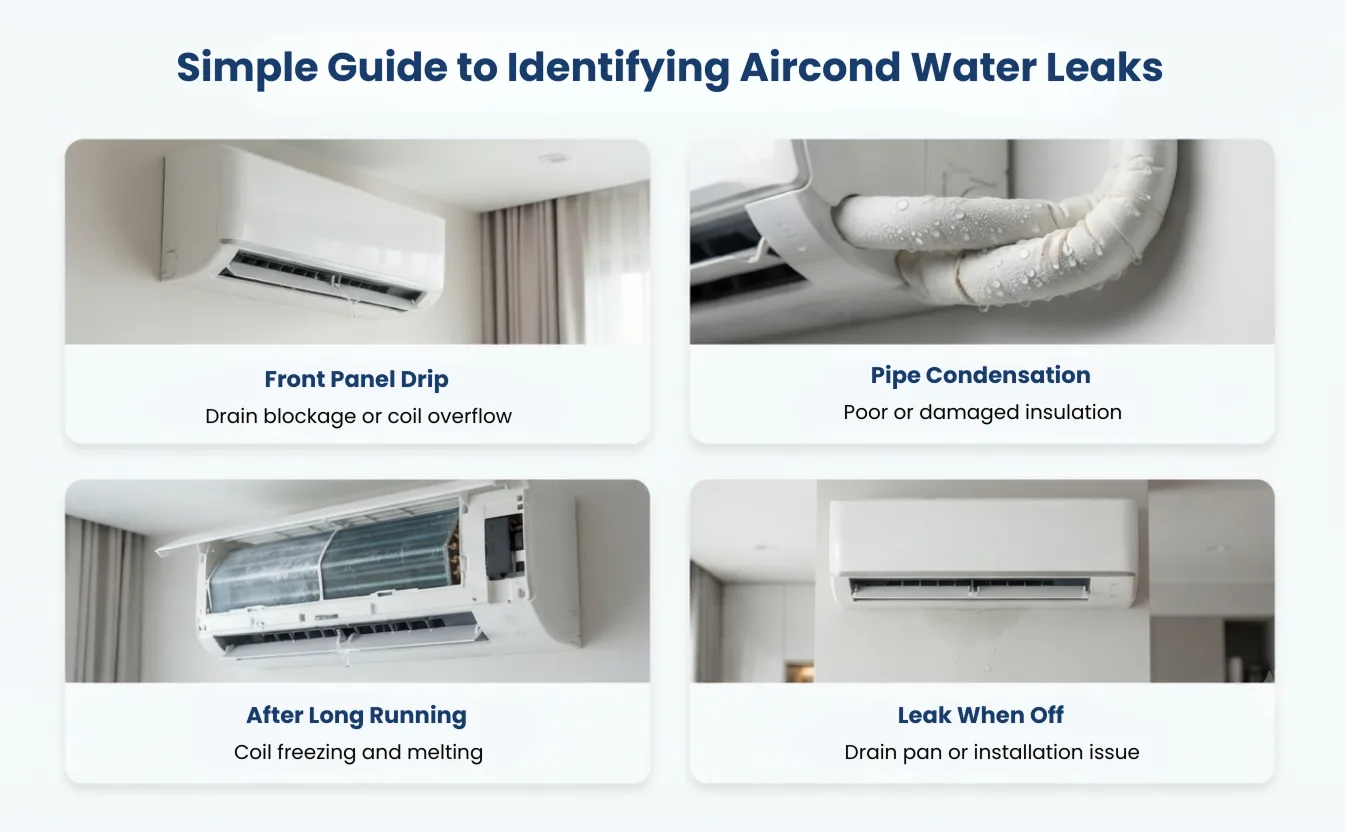
- If water is dripping from the front panel: usually drainage or coil overflow
- If water is dripping along piping: likely insulation issue
- If water appears suddenly after long usage: possible freezing and thawing
- If water is continuous even when off: drain pan or installation issue
This simple pattern can help narrow down the cause quickly.
Common Causes of Aircond Water Leakage
1. Blocked Drainage Pipe (Most Common Cause)
This is the number one reason in Malaysia’s humid climate.
Dust, algae, and organic buildup slowly block the drainage pipe until water can no longer flow out.
Instead of draining outside, water backs up into the indoor unit and overflows.
Signs:
- Water dripping from front panel
- Leak increases during long usage
- Water stains under indoor unit
Solution: Proper drainage flushing using pressure cleaning equipment
2. Evaporator Coil Dirt and Overflow
When the coil is dirty, condensation does not flow smoothly into the drain tray.
Instead, water accumulates unevenly and overflows.
This is more common when the unit has not undergone chemical cleaning for a long period.
Signs:
- Weak airflow
- Musty smell
- Slow dripping or overflow after long operation
3. Coil Freezing Due to Airflow or Gas Issues
Low airflow (dirty filter) or low refrigerant gas can cause the coil to freeze.
When the ice melts, it releases excess water that overwhelms the drainage system.
This is often mistaken as a “random leak” but is actually a performance issue.
Signs:
- Ice on copper pipes
- Weak cooling
- Leak appears after long running hours
Solution: Filter cleaning + gas pressure check + leak detection
4. Improper Installation or Unit Tilt
The indoor unit must be slightly tilted towards the drain outlet.
If it is level or tilted incorrectly, water will pool and overflow from the front.
This is common after renovation work or poor installation.
Signs:
- Leak starts after installation or service
- Water consistently comes from one side
Solution: Re-alignment and mounting correction by technician
5. Drain Pan Damage or Aging
The drain pan collects water before it flows into the pipe.
Over time, it can crack or rust, especially in older units.
Signs:
- Continuous leaking even after cleaning
- Water dripping directly inside unit
Solution: Drain pan repair or replacement
6. Pipe Insulation Condensation (Often Misdiagnosed)
Sometimes the leak is not from the unit itself.
If pipe insulation is damaged, condensation forms on the refrigerant pipe and drips down.
This is common in high humidity environments like Kuala Lumpur and Selangor.
Signs:
- Water follows pipe path
- No water inside indoor unit
- Leak continues even after drain cleaning
Solution: Replace or repair insulation (armaflex)
Quick Self-Check Before Calling a Technician
| Check | What It Means | Action |
|---|---|---|
| Air filter dirty | Restricted airflow | Clean yourself |
| Ice on coil | Gas or airflow issue | Call technician |
| Leak from front panel | Drain blockage | Needs flushing |
| Leak from pipe route | Insulation issue | Technician check |
| Continuous dripping | Drain pan or tilt issue | Professional repair |
What You Should Do Next
Step 1: Stop the Unit if Water Is Heavy
If water is dripping continuously, switch off the aircond to avoid wall damage or electrical risk.
Step 2: Do a Basic Filter Check
A dirty filter is the easiest fix and often contributes to freezing-related leaks.
Step 3: Identify Leak Pattern
Check where the water is coming from. This helps technicians diagnose faster and more accurately.
Step 4: Get Proper Inspection
If the issue continues, professional servicing is needed to check:
- Drainage system
- Coil condition
- Refrigerant level
- Installation alignment
If the issue continues after basic troubleshooting, it’s best to have the system inspected by a qualified technician. A professional can check the drainage system, evaporator coil, refrigerant level, and installation alignment to identify the actual cause of the leak.
If you’re looking for Aircond Service in Cheras, Kuala Lumpur, PT Clean provides inspections, chemical cleaning, and repairs for residential and commercial air conditioning systems.
Prevention
Due to high humidity in Malaysia, aircond systems accumulate moisture-related buildup faster than in other countries.
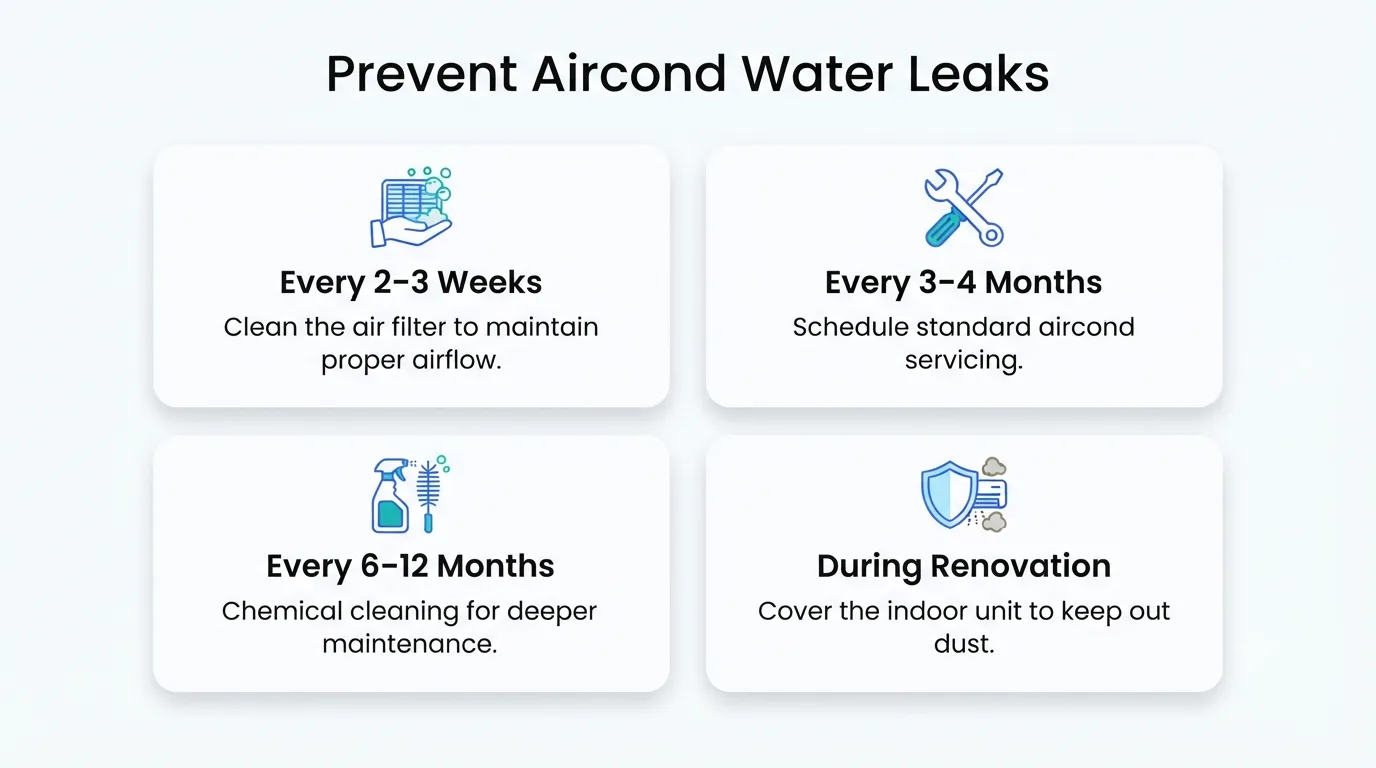
Recommended maintenance:
- Every 2–3 weeks: Clean air filter
- Every 3–4 months: Standard servicing
- Every 6–12 months: Chemical or overhaul cleaning
- During renovation: Protect indoor unit from dust
Also Read: When Should You Service Your Aircond?
Key Takeaway
Aircond water leakage is usually caused by drainage blockage, coil issues, or airflow problems rather than serious system failure.
However, the pattern of leakage is important. Identifying where and when the water appears helps determine whether it is a simple blockage or a deeper mechanical issue.
Early diagnosis prevents ceiling damage, mould growth, and repeated repair costs.
Need Help With Aircond Water Leakage?
If cleaning the filter and checking the leak pattern doesn’t solve the problem, our team provides Aircond Service in Cheras, Kuala Lumpur to diagnose and fix drainage, cooling, and airflow issues before they become more expensive repairs.
Frequently Asked Questions
The most common cause is a blocked condensate drain pipe, which prevents condensation from draining properly. Other possible causes include a dirty air filter, frozen evaporator coil, low refrigerant gas, a damaged drain pan, or incorrect installation.
It depends on the cause. If it’s a small water leak without electrical issues, the unit may still operate temporarily. However, if you notice water near electrical components, burning smells, or heavy leaking, switch off the unit and arrange for a professional inspection as soon as possible.
In many cases, yes. If the leak is caused by a blocked drain pipe, dirty evaporator coil, or clogged filter, a professional aircond service can usually resolve the problem. However, damaged components such as a cracked drain pan or refrigerant leak may require additional repairs.
If your aircond has persistent water leaks, weak cooling, unpleasant odours, or hasn’t been professionally cleaned for a long time, the evaporator coil may have heavy dirt buildup. A chemical cleaning removes contaminants that a standard service cannot reach.
This often indicates a partially blocked drain pipe or a frozen evaporator coil. As more condensation or melted ice builds up during extended operation, the drainage system can no longer cope, causing water to overflow from the indoor unit.
Yes. A clogged air filter restricts airflow, which can cause the evaporator coil to become too cold and freeze. When the ice melts, excess water may overflow from the drain pan and leak from the indoor unit.
Regular maintenance is the best prevention. Clean the air filter every two to four weeks, schedule professional servicing every three to four months, and have the drainage system and evaporator coil inspected regularly to prevent blockages.
If cleaning the air filter doesn’t stop the leak, or you notice ice on the unit, repeated leaking, unusual noises, or poor cooling performance, it’s time to arrange a professional inspection. Delaying repairs may lead to water damage or more expensive aircond repairs.
Disclaimer Statement
We hope you found this article helpful. The information provided is for general cleaning guidance only and may not cover all situations. While we strive for accuracy, results may vary depending on factors such as materials used and cleaning methods applied. We cannot guarantee that all information is error-free. PT Clean Services assumes no responsibility for any errors or omissions. For the best results, we recommend hiring experts such as PT Clean Services. We offer tailored solutions to meet your needs. If you require assistance, explore our cleaning services.
We are at your service.